
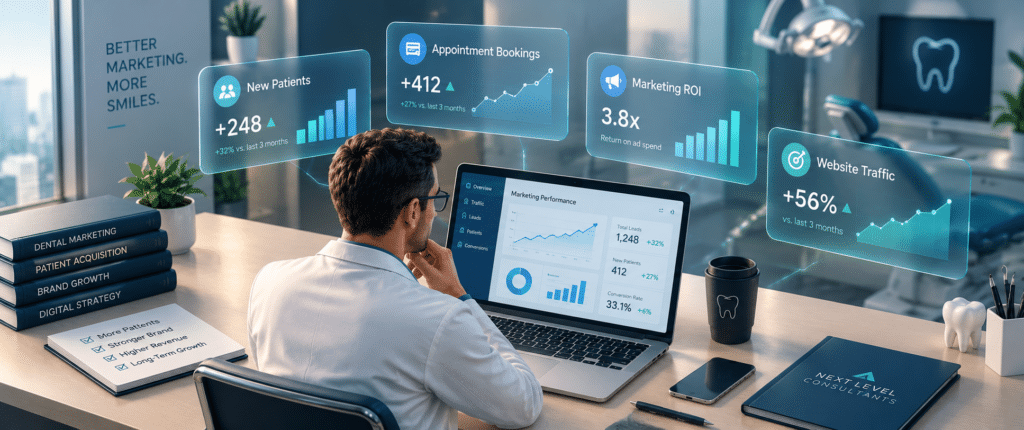
Dental Marketing Strategies for 2027
A Quick Guide to Marketing A Dental Startup in the Next 12 Months
The next twelve months represent the strongest window for starting a dental practice or buying an existing one that we’ve seen in over a decade. Three platform shifts landed at the same time, and together they’ve done something rare: they’ve leveled the competitive playing field between brand-new practices and offices that have spent fifteen years building their digital presence. If you’re sitting on the sidelines weighing ownership, the market conditions right now are working in your favor in ways that won’t last.
The insights here come from a recent Dental Unscripted conversation between Paula Quinn, myself, and Guido Tebano, CMO of Market My Market, a digital marketing agency that specializes in dental and works closely with our startup clients.
How Apple Maps Ads Have Reset Review-Based Competition for Dental Startups
For the past decade, Google has been the only game in town for local dental advertising. Practices that got in early have been stacking reviews since 2012, and in many markets, the top three map-pack positions are locked up by offices with 300, 500, or even 1,000+ Google reviews. A startup with 33 five-star reviews, no matter how legitimate, simply can’t compete visually in that environment. Patients are conditioned to compare review counts before they ever click through to a website.
Apple Maps changed this when it launched its advertising platform in mid-2026. Every dental practice in the country, including the ones with 1,000 Google reviews, starts with zero reviews on Apple Maps. That hasn’t happened since Google Business Profiles became the standard a decade ago.
The reach is significant. Millions of iPhone users navigate through Apple CarPlay daily. When a parent is driving to pick up their kids and searches for a dentist, Apple Maps is the default on that screen. Dental offices and ads will start surfacing in that space. And unlike Google, where the cost per lead for procedures like implants has climbed to $300-$400+, Apple Maps advertising costs are substantially lower right now because competition hasn’t caught up yet.
We’re running Apple Maps ads for a handful of startup clients right now, and cost-per-click is coming in well below what the same keywords cost on Google Ads. Your ad spend goes further, and you’re not fighting against a decade of someone else’s accumulated review volume.
What to do right now: Claim your Apple Maps business profile immediately. You can do this through Apple Business Connect. Begin collecting Apple Maps reviews from day one of operations, and consider running Apple Maps ads while the platform is still in its early adoption phase and costs are low.
Why ChatGPT and AI Search Ads Are Creating a Second Front for Patient Acquisition
Google has never really had meaningful competition in search advertising. Bing existed, but nobody used it on purpose. That’s changed. ChatGPT introduced advertising capabilities in late 2025 and early 2026, and while the rollout is still in beta for healthcare categories, the trajectory is clear.
As Guido put it during our conversation, people trust ChatGPT more than they trust their own research in many cases. It validates their questions. It gives them direct answers. And when a patient types “who is the best dentist near me” or “how much does a dental implant cost,” the AI doesn’t just return a list of links. It synthesizes information, cites sources, and increasingly, it surfaces ads alongside those answers.
Out of the hundreds of dental clients Market My Market manages, about eight have been accepted into ChatGPT’s ad beta so far. There’s no clear pattern yet to who gets accepted. But the ones who are in are getting first-mover data on an entirely new channel before their competitors even know it exists.
For startup practices, this matters because AI search doesn’t care how long you’ve been in business. It cares about whether your website content is unique, whether it actually answers the questions patients are asking, and whether it can be crawled by AI bots. An established practice with a beautiful but content-thin website built five years ago is at a disadvantage against a new practice with fresh, original, market-specific content.
What AI Crawlers Actually Look for on a Dental Practice Website
Showing up in AI-generated search results takes a different approach than traditional SEO.
Your site needs to be crawled by AI bots. That means pushing unique content that doesn’t show up anywhere else on the internet. If you copy text from your website and paste it into a Google search and it matches other sites, you have a plagiarism problem. You won’t rank. If you used ChatGPT to write your website content without substantially rewriting it, there’s a good chance that same content exists on dozens of other dental sites. AI recognizes its own output, and it doesn’t reward recycled material.
We recommend WordPress for dental practice websites, and our marketing partners build on it for a reason. It’s crawlable, content-friendly, and dentists own the site. But the platform is only half the equation. What you put on the site is what actually drives your visibility in AI search.
Your website needs a blogging strategy that answers the specific questions patients in your market are asking. Not generic dental content that could apply to any city in the country. If you’re opening in a suburb of Seattle where a large percentage of the population works at Boeing or Microsoft, your content should address how your office works with those employers’ insurance plans. If your market has a significant Spanish-speaking population, your site should reflect that in both its content and its calls to action.
People ask different questions in different markets. A patient in Scottsdale isn’t searching for the same things as a patient in rural West Virginia or downtown Chicago. Your website needs to reflect the demographics and search behavior of the specific area you’re serving.
The Five Website Elements That Convert Dental Patients in 2027
Your website’s visual design matters less than most dentists think it does. An ugly website with strong content can rank well. A gorgeous website with no substance won’t rank at all. But once a patient finds your site, certain elements drive whether they actually book an appointment or pick up the phone.
Based on the patterns we see across our 400+ startup and acquisition clients, these are the five elements that matter most right now, and they should be visible without scrolling:
| Priority | Website Element | Why It Converts |
|---|---|---|
| 1 | Insurance acceptance / “We work with your insurance” | The number one question patients call to ask. Answer it before they have to call. |
| 2 | “Now accepting new patients” | Removes the hesitation of whether patients will be turned away. |
| 3 | Additional languages spoken | A significant differentiator in diverse markets. Patients want to feel comfortable. |
| 4 | “No insurance? No problem” / in-house membership plans | Younger patients are increasingly skipping traditional dental insurance. In-house membership plans offer an alternative. |
| 5 | Financing options (Cherry, CareCredit, in-house plans) | Patients evaluate dental treatment like any large purchase, focusing on the monthly payment rather than the total cost. |
The DSOs have figured this out. They lead with financing options and accessibility. Independent dentists often resist it because they think it cheapens what they do. It doesn’t. Presenting your services in a way that relates to how your patients actually make buying decisions is not salesy. It’s smart. Patients don’t care what an implant costs in total. They want to know what it costs per month, the same way they look at car payments and mortgage rates on Zillow.
How Google Review Strategy Has Changed for Dental Startups and Acquisitions
Reviews still matter on Google, but the strategy has evolved. There are two threshold numbers that affect Google’s algorithm, and they’re worth knowing: 33 reviews and 100 reviews. Getting to those numbers matters for your ranking. Beyond 100, the volume game has diminishing returns.
It’s not just about accumulating a high number of reviews anymore. Google now factors in review engagement. When you open your Google Business Profile dashboard and it nudges you to respond to recent reviews, that’s not a suggestion. Google is telling you what it weighs in its algorithm. Respond to every review, good and bad.
On the bad reviews, be professional and be HIPAA compliant. Don’t fight with patients through the review platform. Take it offline. Email them separately if you can identify who they are. Every practice gets negative reviews. What matters is how you handle them, and prospective patients are reading your responses to see whether your practice is professional and engaged.
Google’s AI-driven spam detection has also gotten aggressive. We had a client receive five legitimate reviews in a single day and Google removed all of them. The algorithm flagged the velocity as suspicious. So don’t do a big review push in one day. Spread it out. Consistency beats bursts.
ChatGPT is also aggregating review content. It reads what patients are saying about your practice and synthesizes that information when someone asks AI about dentists in your area. Responding to reviews isn’t just about Google’s algorithm anymore. It feeds the data that AI uses to describe your practice to prospective patients.
Why Established Practices Are Losing Ground to New Entrants Right Now
Dentists, as a group, do not like change — that’s been true across fifteen years of working alongside them. Practice owners who’ve been in business for fifteen or twenty years built their patient base on referrals and reputation. They never had to do serious marketing because their chair stayed full.
In the last twelve to eighteen months, many of those same owners are watching their numbers decline and they don’t fully understand why. The answer is that the way patients find and choose a dentist has changed faster than at any point in the last decade, and the practices that didn’t adapt are getting passed over by the ones that did.
This creates an opening for new practices. If you’re launching fresh with a well-structured website, original content, active review management across Google and Apple Maps, and an ad strategy that includes the newer platforms, you are entering the market with tools that your established competitors are either ignoring or haven’t learned to use yet.
As Guido told us, your old strategy is not working. The practices that figure out the new channels will capture the market share. The ones that don’t will keep wondering why their phone isn’t ringing like it used to.
The Demographic Study That Should Come Before Any Marketing Dollar
None of these strategies work in a vacuum. Dental marketing is hyperlocal. A marketing plan that works in Tampa won’t necessarily translate to a suburb of Portland or a rural market in the Midwest. Before you spend a dollar on ads, before you write a single blog post, you need to understand what’s actually happening in the specific market where you’re opening or operating.
That starts with a demographic study. Who lives in your target area? What’s the age distribution? What insurance plans are dominant? What languages are spoken? How many dentists are already serving the population, and what are their strengths and gaps? Are patients searching for implants, pediatric care, sedation dentistry, or general cleanings?
The demographic data drives everything. It tells you which services to highlight on your website, whether Spanish-language content will give you a competitive advantage, whether Apple Maps ads or Google ads will give you better ROI in that specific market. It even tells you whether radio ads or direct mailers might still be effective, because in some rural or suburban markets, those channels still work precisely because everyone else has gone all-digital.
In our work with startups, we’ve seen doctors open in markets where their clinical preferences didn’t align with the population’s needs. A doctor who doesn’t want to see children opening in a market dominated by young families. A doctor who doesn’t place implants opening in an area with a high percentage of patients over 55. These are avoidable mismatches, and a solid demographic study catches them before you sign a lease.
Your Website Content Cannot Be Written Entirely by AI
Can you use AI tools to help build your website content? Yes, as a framework. Should you let ChatGPT or Claude write the whole thing and publish it untouched? No. It will not rank.
AI-generated content that hasn’t been personalized is generic by definition. It reads like what everyone else is producing because it is what everyone else is producing. Search engines, both traditional and AI-powered, are getting better at identifying this. If your content isn’t unique to your practice, your voice, and your market, it blends into the noise.
You have to put your own voice and story into it. Story brand your practice. Talk about why you chose this community. Talk about the specific problems you solve for the patients in your area. The practices that show up in AI search results are the ones creating genuinely original content that AI bots recognize as differentiated and valuable.
You can’t shortcut authenticity. And the irony is that AI rewards originality, which means the practices willing to do the work of creating real, market-specific content will be the ones AI surfaces to patients.
FAQ: Dental Startup Marketing and AI Search in 2026
How much does it cost to advertise a dental practice on Apple Maps?
Apple Maps advertising is still in its early rollout phase, and costs are significantly lower than Google Ads for comparable dental keywords. While Google can run $300-$400+ per implant lead, Apple Maps advertising currently offers a lower cost-per-acquisition because competition on the platform hasn’t matured. Pricing will likely increase as more practices adopt the platform, which is why getting in early provides a financial advantage.
Do I still need Google reviews if Apple Maps is the new platform?
Yes. Google reviews remain critical for ranking in Google’s map pack and for feeding AI systems like ChatGPT that aggregate review data. Apple Maps is an additional platform, not a replacement. The advantage for startups is that Apple Maps reviews start at zero for everyone, so you can compete on equal footing there while you continue building your Google review count toward the 33 and 100 thresholds that affect Google’s algorithm.
How do I get my dental practice to show up in ChatGPT search results?
Your website needs to be crawled by AI bots, which means it needs unique, original content that isn’t duplicated elsewhere on the internet. Build market-specific blog content that answers the questions patients in your area are actually searching for. Use WordPress for its crawlability, ensure your insurance information is structured in dedicated pages rather than just a list of logos, and respond to your Google reviews because ChatGPT aggregates that content to describe your practice.
How much should a dental startup spend on marketing in the first year?
Marketing budgets vary significantly by market type. A practice in a competitive urban area will need more ad spend than one in a suburban or rural market with less competition. The important thing is aligning your spend with a demographic study that tells you what’s actually searchable and competitive in your area. Spending $50,000 on Google Ads in a market where there isn’t enough search volume to support your growth goals is a waste, and that money might go further across Apple Maps, local content, and direct outreach.
Is 2026 actually a good time to open a dental practice, or is the market too saturated?
Market saturation depends entirely on the specific geography and demographics of where you plan to open. Nationally, the combination of new advertising platforms, the AI search shift, and the fact that many established practices have not adapted to these changes creates a legitimate first-mover advantage for new entrants. In our experience working with 400+ dental startups, the startup failure rate with proper planning and consulting support remains extremely low. The question isn’t whether the market is saturated. It’s whether you’re opening in the right market with the right strategy.
Should I hire a marketing company for my dental startup, or can I do it myself?
You can learn the fundamentals, but the platforms are changing so quickly that staying current is a full-time job. Apple Maps ads, ChatGPT advertising betas, Google algorithm updates, AI crawling requirements, HIPAA-compliant review management, these are all moving targets. A marketing company that specializes in dental and stays on top of these changes daily will give you a meaningful advantage over trying to manage it between patient appointments. The key is finding a partner that builds strategy around your specific market demographics rather than applying a one-size-fits-all approach.
Behind every strategy in this guide is a battle-tested consulting methodology refined across hundreds of dental practices nationwide. Developed by founders Michael Dinsio and Paula Quinn, our team brings over 75 years of combined dental industry experience to every client engagement, from leadership development and team training to operational systems, HR structure, and financial benchmarking. If your practice is stuck in a burnout cycle and you’re ready to reset, connect with the Next Level Consultants team to build a plan that actually gets your team and your numbers moving in the right direction.
This article is based on an episode of the Dental Unscripted podcast featuring Michael Dinsio and Paula Quinn of Next Level Consultants. For more episodes on dental practice management, team leadership, and practice ownership, subscribe to Dental Unscripted wherever you listen to podcasts
Last reviewed: September 2026.