
Why Dental Credentialing Takes Longer Than You Think.
Credentialing a Practice You Are Buying.
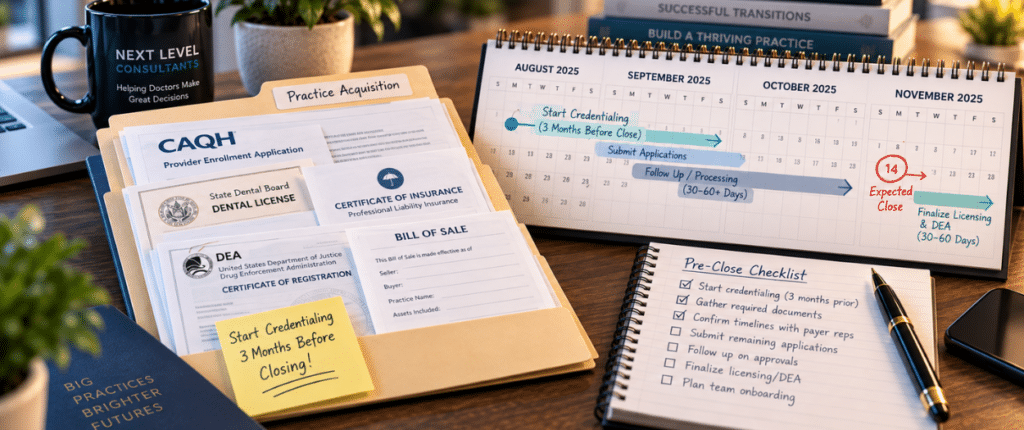
Credentialing after you sign the purchase agreements is not when you first want to hear about getting credentialed for your new practice. We recommend preparing a minimum of 12 weeks prior to closing. The process is time consuming and takes quite a bit of work to complete. Even after the necessary statements and documentation are in the hands of the carriers there is a time frame where you are just waiting for them to respond. Depending on each carrier, or leasing networks, or any other variables, the process can take even longer in some extreme cases! But on average, it’s safe to say 90-120 days of processing time is standard once all your paperwork is complete.
It is critical to get through that credentialing process quickly and cleanly. For a practice seeing 12–15 patients per day and with an average reimbursement of $250–$350 per visit, and when there is a 60-day credentialing gap, that gap could potentially represent $40,000–$60,000 in deferred or reduced revenue. That is money a new owner is counting on during the first few months of ownership, when every dollar matters most.
Dental practice buyers who assume they can simply carry over their associate credentialing into the purchased practice, or those who are delayed until after closing, will find themselves temporarily out of network during their first few months of ownership in that practice.
This guide breaks down what actually happens during credentialing (when buying a dental practice), mistakes that can push the credentialing process beyond the timelines, and the steps you can take before closing day to make sure the transition is as ready as possible going in.
Why Buying a Dental Practice Requires a Different Kind of Credentialing Process
Credentialing an associate into an existing practice compared to credentialing new practice owner are not one in the same. Many times practices can simply add an associate under the current owner’s existing tax ID and insurance contracts. That’s one way to bypass the entire process and move relatively quickly in collecting in network.
But a buyer acquiring a dental practice, however, involves a whole new ownership structure. This includes setting up their own tax ID and organizational NPI. They should be setting up different contracts with insurance carriers and negotiating different rates anyway.
In the event you are indeed buying a dental practice the dental credentialing process involves these three important factors that all need to come together in a timely manner:
- Your contract as the individual provider
- A contract for the practice as a business entity under the new tax ID and organizational NPI
- The necessary termination or transition of the seller’s existing participation
The seller’s existing contract may need to be formally terminated before a new contract can be activated at the same location. Of course this does depend each individual insurance carrier’s requirements.
Why Knowing the Seller’s Insurance Participation Matters To You
Many times buyers will want to mirror the seller’s existing network participation rather than starting from scratch.
That can help maintain continuity for existing patients, but you really do need to know exactly which insurance carriers the practice is currently participating with, and what fee schedules are currently in use.
It is recommended to ask the seller for that information as well as gathering copies of your own insurance contracts before leaving an associate position. It can sometimes be challenging in both situations. You don’t want to trigger the seller’s front office team to start fearing for their lives once they discover the owner is selling to another doctor. In the same token, as an associate, you may need to give your employer notice that you plan on leaving prematurely.
But in any case, you want to successfully obtain your own existing insurance contracts. If you don’t know which carriers and locations you’re currently contracted under, that information can become important when determining how your new ownership arrangement should be credentialed.
This is why we think credentialing deserves a seat at the table alongside financing, the lease agreements, and the other major components of buying a dental practice, not as an afterthought once the purchase is complete.
How the Seller’s Transition Period Affects Your Credentialing Timeline
One negotiation point buyers often do not account for is the seller’s role in getting the credentialing complete during the transition.
The best case scenario is when the seller agrees to stay on for a defined period after closing (typically 30 to 90 days) to maintain clinical continuity while the buyer’s credentialing applications are processing. During that window, the practice can continue billing under the seller’s existing contracts, which keeps patients in-network and revenue flowing at the appropriate rates.
But if the seller’s contract is terminated before the buyer’s new contract is active, there can be a gap where no provider at that location is in-network with certain carriers. That gap is what causes a decline in collections. So timing is of the essence in these delicate matters.
This is worth discussing during the purchase negotiation, not after closing. The length and terms of a seller’s transition period can directly affect how much credentialing risk the buyer absorbs. These terms need to be defined in the asset purchase agreement.
The Realistic Timeline for Dental Credentialing After You Close
We discussed on our podcast how credentialing (when buying a dental practice) is a much harder process to navigate then simply getting credentialed as an associate. Stafani Sandoval, Next Level Consultants’ front office specialist suggests that docs plan for at least 12 weeks once the applications are complete.
That is a rule of thumb and a general guideline, not a guarantee from every insurance carrier. Also, Its important to note, that 12 weeks is after paperwork is complete. Dentists need to collect and organize their required documentation another 6-8 weeks weeks prior to the process in order to avoid any delays.
Each individual carrier processes applications on very different timelines. Each case is decided on an individual basis. Also each case’s timeline is dependent upon on each case’s particular situation or circumstances. A straightforward plan and provider can can move in weeks. A full ownership change with leasing network participation can take months and sometimes longer than most buyers expect.
Here’s how the three most common scenarios compare:
| Scenario | What’s Required | Typical Timeline |
|---|---|---|
| Associate added to an existing owner’s tax ID | Provider added to the owner’s current contracts | As fast as two weeks, carrier-dependent |
| New owner acquiring a practice (new tax ID) | New entity contract, new provider contract, and termination of the seller’s contract | 12 weeks minimum, often longer |
| Leasing network participation | Carrier notified only after the leasing network contract is approved | Up to 90 additional days after network approval |
This table tries to layout the potential ranges in time. A clean process may be around four months, while more complicated situations can extend toward 12 months. Those longer timelines aren’t standard, they’re examples of what can happen when variables enter the application process.
Some of that variation comes down to the carriers themselves.
For example, Delta Dental as a carrier generally doesn’t negotiate fees at the point of an acquisition, meaning there may be little reason to delay submitting that application while waiting to negotiate fees. On the other end of the spectrum, Next Level Consultants’ credentialing team has seen applications where carriers such as Anthem have taken close to a year to finalize! So it really does depend on the specific case and situation.
Leasing networks add another layer of confusion to the process. Once you’re approved and contracted with a network itself, then the network can take up to 90 additional days to notify the individual carriers underneath them in a leasing network.
This means a new owner can be approved with a leasing network but yet still shows as out of network with specific insurance plans. Working with a knowledgeable dental credentialing professional will save you hours of frustration and confusion, because credentialing professionals deal with and work with these insurance carriers on a daily basis. They know what questions to ask and how to navigate each individual carriers rules and stipulations.
Where Dental Credentialing Fits In Your Practice Acquisition Timeline
The mistake most buyers make isn’t misunderstanding the credentialing process itself, it’s not knowing when to start. Paula Quinn confessed on the Dental Unscripted podcast that she sat down and manually filled out every application herself by hand without any rhyme or reason. She just to get into network as a new practice owner. She does not recommend doing that by the way!
So here’s a general framework for how the credentialing process maps to the practice purchase milestones:
- LOI executed — Begin identifying your credentialing team and gathering your own insurance participation records. You don’t need the seller’s information yet, but you should know who will handle your applications.
- During due diligence — Request the seller’s full list of carrier participations and fee schedules. This is when you confirm which networks you want to mirror and whether any carrier contracts have unusual terms.
- Financing approved, closing date in sight — Your credentialing team should be preparing applications so they’re ready to submit the moment final documents are available.
- At closing — Bill of sale, malpractice documentation, and final signatures become available. Applications should go out within days, not weeks.
That sequencing matters because working with a good credentialing team builds the application in advance and drops in the final documents at closing so the clock starts on immediately.
The Credentialing Mistakes That Delay Timelines, And How to Avoid Each One
Most credentialing delays aren’t due to the slow carriers processing times. They’re usually delayed because the documentation wasn’t ready when the deadline was due. The application needs to be submitted in a timely manner. Here are the six issues that hold up the process most often, and what to do about each one before closing.
- Submitting malpractice coverage that isn’t actually yours:
- Associates are often covered by an employer’s malpractice policy.
- When you become an owner, you need the appropriate malpractice coverage in your own name.
- If that documentation isn’t ready, the credentialing process will stall while you’re waiting for it.
- Get your individual malpractice policy setup early in the acquisition process so the certificate is in your file before applications go out.
- Don’t assume your employer’s coverage follows you into ownership.
- Missing the Bill of Sale
- The bill of sale is a critical piece of documentation for practice owners
- Insurance companies generally won’t finalize acquisition-related contracts without the bill of sale.
- Make sure your attorney, broker, and credentialing team all understand the bill of sale is needed at closing.
- Your credentialing team can build the rest of the application in advance so it’s ready to submit the moment that document is signed.
- An outdated CAQH profile
- Carriers pull from your CAQH ProView profile during credentialing
- If your license, practice location, or provider details are expired or incomplete, the application can stall before it even reaches a reviewer.
- Update your profile before you begin submitting applications (not when a carrier flags it as missing from the applicaiton).
- Check your profile early in the acquisition process (during due diligence at the latest)
- Keep it current through closing. The same goes for your state license and DEA registration.
- Not knowing your current insurance contracts
- Before leaving an associate position, it’s worth getting copies of the insurance contracts you’re currently participating.
- This information can help determine where you’re currently contracted and how that may affect participation at your new practice.
- If you’re unsure of your existing participation, you can also contact the insurance network directly to determine whether you have an active contract at a particular location.
- Skipping the re-credentialing step
- Being previously credentialed as an associate does not necessarily mean you can simply update your existing information when you become a practice owner:
- Moving from an associate role into ownership typically requires a separate re-credentialing application.
- It’s a different contracting structure, not a simple information update.
- Assume you’ll need to re-credential and let your credentialing team confirm which carriers will accept a transfer versus which ones require a new application.
What Does “Being Out of Network” Actually Mean For an Acquisition
Being temporarily out of network during a credentialing transition doesn’t necessarily mean you need to completely change how your office operates. It’s also important to note the distinction between temporarily being out of network because a new owner’s contract is still processing and making the strategic decision to permanently leave an insurance network. Those are two very different situations, when credentialing your newly purchased dental practice.
So to clarify, if you’re temporarily out of network while your application is processing, your patient experience doesn’t need to change. You continue billing at the same fees… simple as that. The patient’s will continue to co-pay and that usually stays the same. You submit a claim to the carrier just like you would if you were in-network.
How does being out of network affect your profit/revenue?
What actually happens on the back end is, the insurance company processes the claim as “out-of-network”, which means the reimbursement they send to the practice may be different from what you’d receive under the in-network contracted rate. In many cases, that reimbursement is lower because the carrier isn’t required to honor the current fee schedule while the new owner is out of network.
So your practice absorbs that loss of reimbursement during the transition period. You’re not passing it along to the patient and you’re not changing how your front desk handles billing. From the patient’s perspective, nothing has changed. But, be aware of any communication from the insurance carriers directly to your patients about the network changes in the office.
From the new owner, you might have to collect less per claim for the first few months until your credentialing is complete and claims start processing again at in-network rates. That temporary revenue dip is the real cost of a credentialing late in the process, and it’s another reason the preparation timeline matters. The shorter that crossover gap is, the less your practice absorbs those lower reimbursement rates.
What About the Patient’s Annual Maximum?
There is one important consideration that your front-office team needs to understand.
When the practice is temporarily out of network, the insurance company may reimburse at a higher allowed amount than the in-network contracted rate. That sounds like a positive, but it can cause the patient’s annual benefit maximum to be used up faster than expected.
Here’s what that looks like in practice:
Say a patient needs a crown and the in-network contracted rate would have been $1,000. Out of network, the carrier’s allowed amount might be $1,300. So the patient’s co-pay stays the same, but the insurance company applies $1,300 against the annual maximum instead of $1,000.
If that patient has a $1,500 annual max, the difference between $500 remaining and $200 remaining would affect whether they can complete additional treatment that year. That’s why your team needs to understand the mechanics and communicate proactively with patients who have significant treatment planned during this transition window.
How Your Team Discusses Insurance With Patients Matters
There is also a big importance in how your team frames insurance coverage.
Rather than presenting insurance as something the patient is automatically entitled to… the team should be discussing insurance as assistance toward the patient’s treatment.
For example, informing the patient that their plan is assisting in 25% of their treatment creates a very different narrative than apologizing that the insurance carrier “isn’t covering” treatment for the patient.
The underlying dollar amount isn’t changing. The way the team communicates insurance coverage needs to change. Now that may be challenging walking into an newly acquired practice, but everyone needs to work together for the sake of the patient and their care.
Next Level Consultants’ front office training program specifically address how to have these insurance conversations with patients. The front office training program covers everything from top to bottom and addressing effective patient communication. Your team needs to feel confident having these conversations rather than apologetic when discussing billing and insurance coverage.
The Bottom Line for Dental Practice Buyers Credentialing For Their Practice
If you’re buying a dental practice, don’t build your transition plan around the assumption that insurance credentialing will be completed in only a few of weeks. That is pitfall number one.
In a clean, ideal scenario, plan for at least 12 weeks. But understand that carrier-specific circumstances can make the process significantly longer, with the podcast discussing scenarios ranging from roughly four months to as long as 12 months.
More importantly, don’t assume that your previous associate credentialing automatically transfers when you become the owner. A practice acquisition involves:
- A new tax ID
- A new organizational NPI
- A new provider contract
- A new entity contract
- Termination or transition of the seller’s existing contract
- Possible recredentialing
- New malpractice documentation
- Updated CAQH and licensing information
- Carrier-specific requirements
The best time to deal with those issues is before you close. Get a checklist, gather the documentation, understand the seller’s participation, and prepare as much of the application process as possible before closing. You CAN’T control how quickly every insurance carrier processes an application.
But you CAN control how prepared you are when the application goes in.
How Next Level Consultants Can Help with Buyers Through the Dental Credentialing Process
Next Level Consultants’ credentialing team handles this process for close to 40 practice acquisitions a year, in addition to new startups. For a buyer, that means credentialing doesn’t have to be another piece of the acquisition puzzle that you’re trying to muddle through. Our Buyer Representation process simultaneously helps you manage financing, the lease, the due diligence process, and the negotiation process, along with credentialing.
Our front office support and credentialing services have been a part of hundreds of transitions. Transitions are a whole other ball of wax then simply credentialing an associate. Managing the credentialing process through a transition can only be effectively done by expereinced administrative professionals.
But once you’re fully in network, then you can focus on optimizing billing, patient flows and patient experience, optimizing revenue and providing a clear return on investment by working with our dental practice management consulting team. We can help address any operational challenge when running the practice.
Just remember the goal isn’t to promise that every insurance carrier will move quickly. It’s to make sure that your side of the process is organized, accurate, and ready to move as soon as the carrier allows it. Getting you the best rates, and the best network for your patients on time.
Frequently Asked Questions
How long does dental credentialing take after buying a practice?
In a clean, uncomplicated scenario, it is recommended to plan for at least 12 weeks. Actual timelines vary by carrier and circumstances, and the discussion references cases ranging from approximately four months to as long as 12 months.
What’s the difference between credentialing and contracting for a new practice owner?
Credentialing verifies the provider’s qualifications and information. Contracting establishes the agreement that places the provider and practice entity into an insurance carrier’s network under the applicable fee schedule. A practice acquisition can require both provider and entity contracting.
Can I keep my credentialing from my associate job when I buy a practice?
Not necessarily. An associate may have been credentialed under the existing owner’s tax ID and contracts. Becoming the practice owner creates a different ownership and contracting structure, and re-credentialing may be required depending on the circumstances.
Does being temporarily out-of-network hurt patient retention?
It doesn’t have to, as long as the front office keeps billing consistent and explains the situation clearly. Patients who understand that their coverage and copay haven’t changed rarely notice or care about the practice’s network status behind the scenes.
Why do some insurance carriers take so much longer than others?
Carriers have different processing timelines, and leasing networks can add another layer. Leasing networks can take up to 90 additional days to notify individual carriers after the network contract is approved.
What’s one of the most common mistakes that delays dental credentialing after an acquisition?
Not having the necessary documentation ready. Particularly malpractice coverage, the bill of sale, current CAQH information, and other professional credentials can all delay the process. Incomplete or inaccurate applications can also send an application back into the carrier’s queue.
What documents does a dentist need before starting the credentialing process?
The core documents are a signed bill of sale, malpractice coverage in the new owner’s name, an updated CAQH profile, a current state license, and DEA registration. Gathering these before closing, rather than after, is the single biggest factor in a faster timeline.
Can dental insurance reimbursement rates be renegotiated during credentialing?
In some cases, yes, though this varies significantly by carrier. Carriers like Delta Dental typically don’t negotiate individual fee schedules during initial credentialing, while other networks leave more room to negotiate improved rates, particularly for buyers coming in below the seller’s existing fees.
Behind every strategy in this guide is a battle-tested acquisition methodology refined across more than 300 dental practice acquisitions nationwide. Developed by founders Michael Dinsio and Paula Quinn, our team brings over 75 years of combined dental industry experience to support every phase of your acquisition, from due diligence and credentialing to lease assignment, staff transition, and day-one operational readiness. If you're evaluating a practice to buy or preparing to close, Connect with the team to make sure your credentialing and transition plan is locked in before closing day.